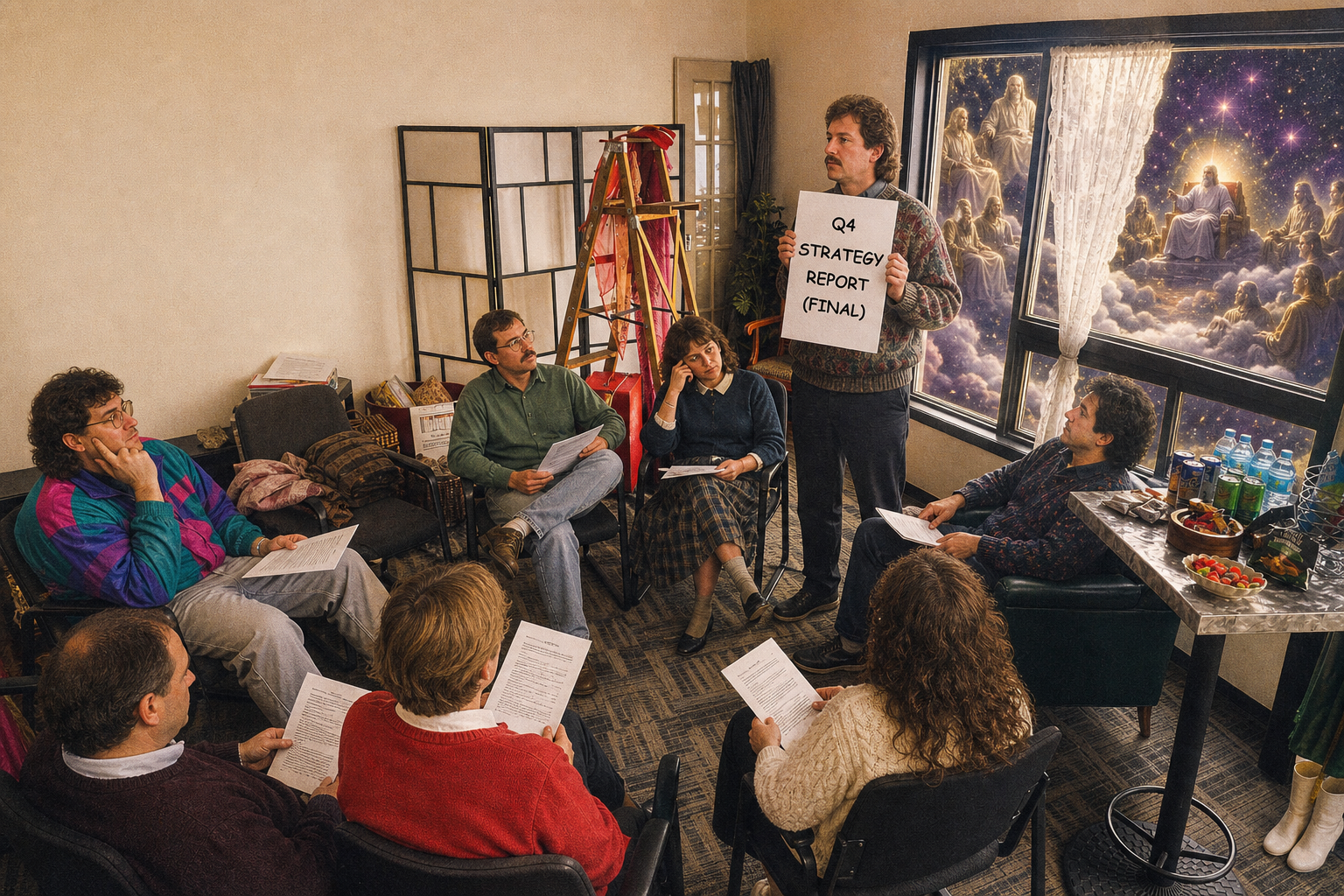
The joke headline imagines a suburban zoning committee accidentally sending a report to an “omnipotent deity council” formatted in Comic Sans. It’s funny because real zoning committees are almost aggressively unglamorous: they process permits, review setback requirements, and file paperwork that keeps sidewalks, streetlights, and community events running on schedule. That unglamorous machinery is also what makes something like a community Mud Run possible in the first place, and it is worth asking whether an obstacle race can become a parable for an entire country.
Every autumn, thousands of Canadians line up at the start of a mud run, fully aware they’re about to get soaked, scraped, and stuck knee-deep in muck. They register anyway, some even eagerly. There’s a lesson in that willingness to wade into the mess rather than skirt around it — one our national conversation could stand to learn from.
Mud runs strip away pretense. You can’t finish one without getting dirty, and you can’t build a fairer country without confronting uncomfortable truths. The work of the Truth and Reconciliation Commission, ongoing debates over housing and inequality, the slow reckoning with our environmental footprint — these are Canada’s obstacle courses. There is no clean route through them, only through.
Progress, like a mud run, isn’t measured by how clean you stay. It’s measured by how far you’re willing to crawl through the mess to reach the other side.
But mud runs also reward preparation. Nobody shows up untrained and expects to finish well. Runners condition their bodies, study the course, and set goals before the starting gun. Canada needs the same discipline: clear objectives on healthcare, education, and innovation, backed by real plans rather than good intentions. Ambition without preparation is just a wish.
> ”Progress, like a mud run, isn’t measured by how clean you stay. It’s measured by how far you’re willing to crawl through the mess to reach the other side.”
Then there’s the question of solo versus team. Some runners tackle the course alone, relying on grit and self-reliance. Others link arms with teammates, hauling each other over walls and through pits. Both approaches have their place. Canada’s entrepreneurs and independent thinkers push the country forward through sheer initiative, while our social programs and community institutions prove that shared effort gets more people across the finish line. A resilient nation needs room for both instincts, not a forced choice between them.
What mud runs teach most clearly, though, is how to fall. Every participant slips at some point — in the mud, over a wall, into a pit of cold water. The race isn’t decided by whether you fall, but by whether you get back up. Canada has stumbled too: recessions, political division, historical failures we’re still reckoning with. What defines us isn’t the absence of those falls but our willingness to rise, muddy and clear-eyed, and keep moving.
There’s a reason mud runs end not with silence but with cheering — exhausted strangers helping each other over the final wall, covered in the same dirt, laughing at what they’ve survived together. That’s the spirit worth bottling: not a country that avoids the mess, but one that wades in, prepares seriously, supports its runners, and gets back up every time.
If we bring that same spirit to our national challenges — climate change, inequality, reconciliation — we won’t just finish the race. We’ll cross the line together, dirtier and stronger for it.